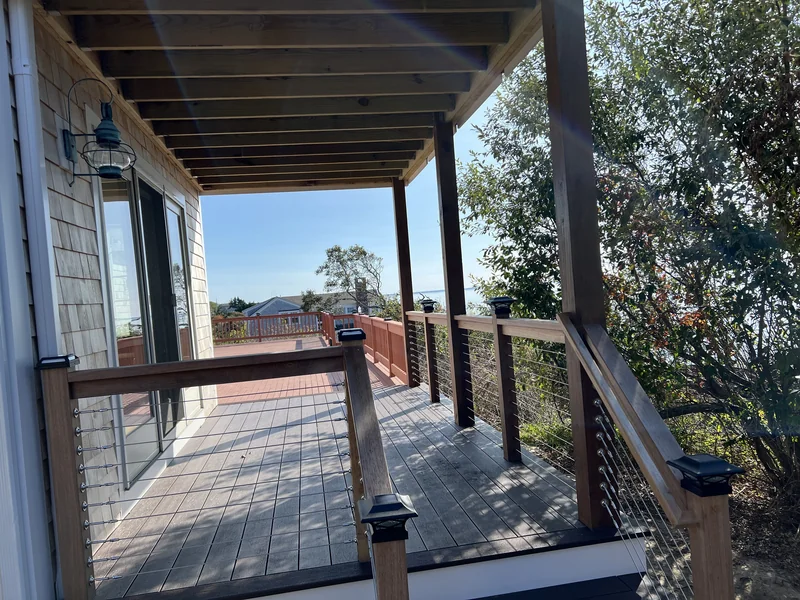
From the BaySide project gallery. This photo illustrates an application; the wood species and decking product are not identified.
01 / THE SURFACE UNDERFOOT
Wood, composite or PVC?
Start with the appearance and maintenance you want. Then match the exact product to sun exposure, moisture, ventilation and the structure below it.
01
Natural wood
Real boards with grain, knots and color variation. Options include appropriately treated lumber, suitable cedar and purpose-made hardwood decking.
Good fit
A natural feel and a surface that can often be refinished, with an owner willing to maintain it.
Care
Clean, inspect and renew the finish as the wood, exposure and coating require. Wood can check, splinter or move as its moisture changes.
Decide first
The species, grade, treatment, board profile and desired finish. A wood name alone does not establish suitability outdoors.
02
Composite
Decking commonly made from wood fibers and plastic. Many current products have a protective cap, with different grain patterns, colors and profiles.
Good fit
Homeowners who want a wood-like look with less recurring finishing work.
Care
Regular cleaning still matters. Use the product’s care guide for stains, debris and any pressure-washing limits.
Decide first
Compare the actual product line, heat in sunlight, scratch resistance, approved fasteners and joist-spacing requirements.
03
PVC
Polymer decking made without wood fibers in the board core. It is a different material from wood-plastic composite, even when the surfaces look similar.
Good fit
A low-maintenance deck where moisture resistance and a specific color or finish are priorities.
Care
Clean with approved products. Check restrictions on mats, rubber-backed items, chemicals and concentrated reflected heat.
Decide first
Follow the exact installation guide for movement, gaps and fastening. PVC can also become hot in direct sun.
“Pine” covers several softwoods. Eastern white pine is familiar in New England trim and paneling. Southern yellow pine is a different commercial group, often used for structural and pressure-treated lumber.
Typical applications
Interior trim, wall or ceiling boards and selected millwork. Properly graded and treated pine can serve in outdoor deck applications.
What changes the choice
Knots, grade, surface hardness and moisture condition. Softer finish boards can dent in busy areas.
Keep the distinction: ordinary untreated interior pine is not interchangeable with properly specified pressure-treated deck lumber.
Poplar
Interior hardwood
In U.S. millwork, “poplar” commonly means yellow-poplar, also called tulipwood. Its relatively even texture makes it useful for painted interior work; natural color can include cream, greenish and brown areas.
Typical applications
Paint-grade trim, cabinetry parts, built-ins and interior millwork.
What changes the choice
It is a hardwood botanically, but that does not make it especially hard or naturally durable outside.
Exterior caution: untreated yellow-poplar is not a general recommendation for an exposed deck or persistently wet exterior detail.
Oak
Red & white oak
Oak brings visible grain and is widely used in interior woodwork. Red oak and white oak are distinct groups; color alone is not a reliable way to identify them.
Typical applications
Interior flooring, stairs, cabinetry and furniture when the grade and construction suit the job.
The key difference
White oak heartwood has better natural decay resistance than red oak. Red oak is mainly an interior choice. White oak exterior uses still need careful specification and moisture detailing.
No blanket outdoor approval: “oak” is too broad a specification for a deck. Heartwood durability does not apply equally to sapwood.
Cedar
Several species
Cedar is associated with shingles, siding and exterior woodwork. Eastern white cedar and Western red cedar are different species, with different products and grades.
Typical applications
White cedar shingles are a familiar Cape Cod exterior finish. Western red cedar is also used for siding, trim and suitable decking products.
What changes the choice
Natural decay resistance is strongest in suitable heartwood. Cedar is relatively soft and can mark under wear; an unfinished surface changes color with exposure.
Check the product: shingle stock, trim boards and structural or decking grades are not interchangeable. Drainage and compatible fasteners still matter.
Pressure-treated
PT = treatment
PT describes a preservative treatment, not a wood species. It improves resistance to decay and insects for the exposure stated on the lumber’s end tag.
Typical applications
Properly specified deck framing, posts, rail components and deck boards. Species, grade and treatment category must all suit the role.
Read the tag
Above-ground and ground-contact ratings differ. Some above-ground conditions also require ground-contact treatment because of moisture exposure or hard-to-replace structural members.
PT is not waterproof: allow for moisture movement, follow guidance for cut ends, and use compatible connectors and fasteners. Finish only when the lumber meets the coating’s moisture requirements.
Mahogany & ipê
Exterior options
Local suppliers offer hardwood decking under names such as mahogany and ipê. These boards appeal to homeowners who want natural grain and richer tones.
Typical applications
Purpose-made exterior decking and selected porch or railing components.
Check the actual species
“Mahogany” can be a trade name for different woods, including meranti or batu/balau products. Do not assume they share the properties of true mahogany. Ipê is a dense hardwood that needs its own fastening and installation details.
Plan the finish: ask about color change, refinishing, responsible sourcing and the supplier’s exact species, grade and installation guidance.
Maple & cherry
Interior detail
These hardwoods offer alternatives to oak for cabinetry and custom interiors. Maple often has a lighter, finer-grained appearance; cherry has warmer tones that change with age and light.
Typical applications
Cabinetry, furniture, built-ins and specialty millwork. Hard maple also appears in flooring and work surfaces.
What changes the choice
Hard and soft maple are different groups. Review a finished sample for color, grain and how the selected coating behaves.
Different purpose: these interior choices are not general substitutes for exposed decking or treated structural lumber.
Framing lumber
Structure first
Spruce-pine-fir (SPF) and Douglas fir-larch are commercial species groups found in structural lumber. The grade stamp and design requirements are more useful than choosing by appearance.
Typical applications
Wall, floor and roof framing where the specified size, grade and exposure are appropriate.
What changes the choice
Loads, spans, connections and moisture exposure. Exterior deck framing needs an appropriate durable or preservative-treated specification.
Before re-decking: a new surface does not confirm that the existing frame is sound. Review the structure, ledger, flashing and connections separately.
Local supplier ranges are a useful starting point. They show what is offered for different jobs, not a market-wide ranking of the most-used woods.
Decks and porches: pressure-treated lumber, hardwood decking such as mahogany and ipê, and composite or PVC systems are offered by Cape Cod suppliers.
Shingles and siding: white cedar shingles are closely associated with the Cape’s traditional exterior appearance. Western red cedar is another exterior material option.
Interior finish work: pine, poplar, oak, maple and cherry appear in local millwork offerings. Choose by the intended paint or stain finish, wear and design.
Coastal exposure calls for careful drainage, ventilation, fastening and maintenance. Salt-exposed connections need an appropriate corrosion-resistance specification; a durable deck board cannot make an unsuitable connection safe.
Regional sources and technical references are linked below. Availability varies with the supplier, grade and project.
04 / BEFORE YOU CHOOSE
Bring the application into the decision.
There is no single best material for every Cape Cod home. These three conversations help narrow the options.
1. Where will it live?
Interior or exterior? Covered or fully exposed? Consider splash, shade, direct sun and drying. A porch ceiling, deck board and buried post need different specifications.
2. How should it age?
Decide whether you want painted wood, a maintained natural tone or a weathered appearance. Compare actual samples in the site’s light. Low maintenance still includes cleaning and inspection.
3. What is the full scope?
Include framing, flashing, stairs, railings and connections in the discussion. Compare the installed scope and future care rather than the price of one board.
FROM MATERIAL TO PROJECT
Let’s find what fits your home.
Send the project location, photos, approximate dimensions and the materials you are considering. We’ll discuss the scope and the next step.
Original summaries by BaySide, informed by the references below. Technical guidance takes priority over a general material description. Supplier listings describe their own ranges and are not independent usage statistics.